A familiar name appears on your calendar. You remember liking the last conversation, and you are fairly sure you offered to send something. Was it the article about workshops, the venue list, or the introduction to your friend? The meeting is about to start, and your memory is presenting several confident options.
A small pre-meeting brief can help you arrive with the right context. It gives you a way to review the previous conversation, check unfinished promises, and separate what you know from what may have changed. You are preparing to listen to the person in front of you, rather than trying to memorize a dossier about them.
The short answer
Read your last exchange and any relevant note, check your own unfinished commitments, and write down the current purpose of the meeting. Mark old or uncertain information as something to confirm. Choose a few open questions, then keep the brief small enough to scan before you start.
Start with the conversation you actually had
Your own recent exchange is usually the most useful place to begin. It can tell you why the meeting exists, what the other person expects, and whether you already agreed on a topic. Read that before collecting new information. A polished public profile will not remind you that you promised to check a link or that they asked to keep this meeting short.
Look for a date on the note and distinguish a direct statement from your interpretation. “Mentioned exploring a workshop in May” is a record of something they said at a particular time. “Runs workshops” may be an assumption that has grown while the note sat untouched. When the source is unclear, keep the uncertainty rather than building more preparation on top of it.
If you cannot remember something important, plan to ask naturally. “Last time you were exploring a workshop. Is that still what you’re focusing on?” gives the person room to update you. It is more comfortable than performing certainty and hoping they will quietly repair the details.
Review what you said you would do
Check your commitments before developing new questions. If you offered a resource, see whether you actually sent it and whether the link still works. If you were going to make an introduction, check the current permission from both people rather than assuming an old conversation still covers it. A promise is not completed merely because you saved a reminder.
If something is unfinished, decide what you can honestly do now. You may be able to complete it before the meeting, or you may need to acknowledge that you did not follow through. Avoid inventing a new deadline to make the opening feel better. A clear explanation and a realistic next step are more useful than another promise you have not thought through.
A fictional commitment check
I offered to send the public venue checklist. The message history shows that I sent it on 8 October. Maya has not commented on it, and I should not assume she has read it. If it is relevant to today’s discussion, I can ask whether it was useful.
Check only the current context that matters
Sometimes a small amount of public information will help: a role change the person announced, a project update they sent you, or an organization’s current description of its work. Use the original source where possible and note when it was published. A search summary can be a useful pointer, but it may combine people with similar names or repeat something that is no longer current.
Relevance is the filter. You do not need their family details, private social posts, or a list of every place they have been. If they shared something personal in confidence, consider whether it belongs in a stored brief at all. Preparation should make the conversation more considerate, not give you an excuse to surface information they did not expect you to collect.
When using an AI-generated brief, check any fact that affects your opening question or decision against a reliable source. Keep a clear line between confirmed context and a possible match. It is better to ask someone about their current work than to congratulate them on a promotion belonging to a different person with the same name.
Build a brief you can scan in a few minutes
The example below is fictional. It brings together the relationship, the purpose of today’s meeting and the questions that still need an answer. The time you spend preparing should match the stakes; a casual catch-up does not need the same level of review as a project decision.
Pre-meeting brief: fictional example
Person: Maya, met at the Riverside design meetup.
Last conversation: 1 October. Maya was exploring a workshop for freelance designers and had not chosen a venue.
Today’s purpose: Compare ideas for an opening exercise, as agreed in the invitation.
My completed commitment: Sent the public venue checklist on 8 October. Do not assume it has been read.
Current confirmed context: Her latest message says the workshop is still being planned.
Needs checking: Venue and date may have changed. The earlier idea of a weekend session was tentative.
Questions: What have you decided since we last spoke? Which part of the opening exercise feels hardest? What would be useful to leave with today?
What I can contribute: A public example exercise I have reviewed and can share.
Afterward: Update the context and record only the next steps we actually agree.
Use the brief as a starting point
Open by checking what the person wants from the conversation today. They may have a new priority, and the purpose in your calendar may no longer be the most useful one. “I had us down to compare the opening exercise; is that still the best use of the time?” is a simple way to let them redirect the meeting.
Keep your notes nearby if that helps, but do not make the conversation a test of whether the person matches your brief. If a remembered detail is wrong, accept the correction and move on. You can update the note later. The point of preparation is to spend less of the conversation reconstructing the past and more of it understanding what matters now.
It is also fine to leave a topic alone. A person may have changed direction, decided against a project, or no longer want to discuss something they once mentioned. Your record preserves past context; it does not create a continuing claim on their attention.
Refresh the record after the meeting
Afterward, update the details that changed and separate new commitments from possibilities you discussed. Keep dates attached to old information when the history is still useful, and remove unnecessary detail rather than accumulating an ever-longer portrait. A concise current note will make the next preparation easier.
Kontextual keeps contacts, notes, Lists and follow-up reminders together so you can review the person alongside the context you saved. Use the brief as a small layer over that record, with links back to a relevant source where appropriate. If you are still deciding how to restart a dormant connection, the reconnection guide covers the message itself. This preparation begins once there is a conversation to get ready for.
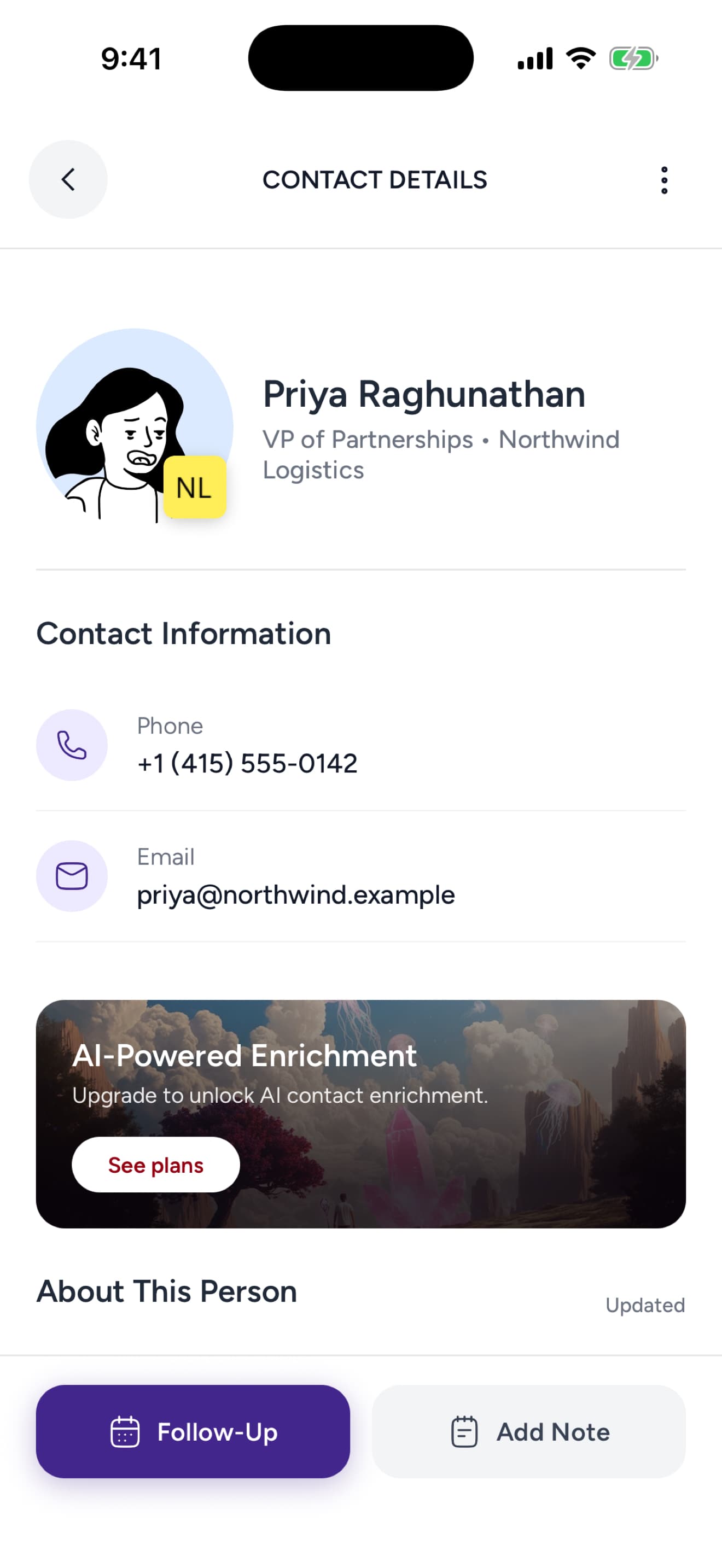
A contact detail view brings the relationship context into one place. Existing Kontextual product-design export; sample content is illustrative.

Sources and scope
- Atlassian: tracking meeting action items
Background on reviewing outstanding actions before the next meeting. The person-focused brief and examples here are original.