You meet someone at a conference, spend half an hour talking about something you’re both interested in, and leave with every intention of staying in touch. Maybe they’re working on a problem you’ve been thinking about, or they mention a book you want to read. You exchange details and tell yourself you’ll send a message when you get home. Then work gets busy, the weekend arrives, and by the time you remember, a few weeks have passed.
That’s often when the message becomes harder to write. You start wondering whether they’ll remember you, whether you’ve left it too long, or whether getting in touch now will look like you need something. What could have been a straightforward hello turns into a draft you keep editing and never send. If that sounds familiar, it helps to think about what you would want to receive from someone in the same position: probably enough detail to remember the conversation, a genuine reason they thought of you, and a message you can comfortably reply to.
The short answer
Give the person enough context to place you, explain what brought them to mind, and make any question or invitation clear. If you owe them something, acknowledge it and follow through; otherwise, the passage of time does not need to become the subject of the whole message.
Check what still holds true
Before you write, read your last exchange or the note you made when you met. It may remind you of something useful, but it is also a record of a particular moment: the person might have changed jobs, finished the project you discussed, or moved on from a problem that felt urgent then. “Are you still working on the workshop?” leaves room for that change in a way that “How is your workshop going?” may not.
The same care applies to the channel you choose. An old conversation thread is usually an easier starting point than an unfamiliar number, and an address they offered for work can be appropriate for a relevant professional message. If that address no longer works, avoid treating the gap as a reason to hunt down private contact details. And if they previously asked you not to contact them, time passing does not undo that request.
Give them somewhere to pick up
“Hey, remember me?” puts most of the work on the other person. They have to place your name, remember where you met, and work out why you’re reaching out before the conversation can go anywhere. A shared detail makes that easier, especially if you met at an event where you both spoke to dozens of people. You don’t need to recap the entire evening; choose the part that connects naturally to what you want to say now.
For example, here is a fictional message you could adapt:
Someone you met once at an event
Hey Maya, we met at the design meetup last month and talked about your move into freelancing. I came across the portfolio workshop you mentioned and finally signed up, so I thought I’d say thanks for the recommendation. How have the first few weeks been?
There’s a reason for the message, enough context to place you, and a question that follows from your last conversation. You’re giving the relationship somewhere to continue without expecting the other person to remember every detail. If you don’t have an article, event or recommendation to share, you can still ask about something they told you mattered to them. Just keep it genuine; an ordinary check-in is more comfortable to receive than a manufactured excuse to get in touch.
Adapt the message to the relationship
The same basic approach works for different relationships, but the amount of explanation should change. A former teammate probably does not need the story of how you met, while someone you spoke to once may need a little more help placing you. These additional examples are fictional too; use the details that are true for your own connection.
An old colleague
Hi Leo, I found our old launch-day checklist while sorting some files and thought of you. I’m still using your trick of writing the handover before the project ends. How have you been? If you fancy catching up, I’d enjoy a coffee sometime this month.
Here, the shared experience does most of the work. The invitation is clear without implying that a meeting is the only acceptable response, and the person can simply reply with an update if that suits them better. There is no need to account for every month since you last spoke.
If you promised something, acknowledge that too
The situation is a little different if you said you would send a resource or make an introduction and never followed through. In that case, briefly acknowledge the delay and do what you said you would do. “I realised I never sent you the article we discussed. Sorry about that; here it is” is usually a better starting point than several paragraphs explaining how busy you’ve been.
A promise you did not keep
Hi Priya, we spoke last autumn about research interviews, and I said I would send our question guide. I didn’t follow through, and I’m sorry. Here it is: [link]. The opening questions are the section we discussed. Your project may have moved on, but I wanted to send what I promised. No need to reply.
Check that you can still share the resource and that the link works before sending. If the original promise was an introduction, ask the other person whether they are still comfortable with it before connecting anyone. If you can no longer deliver what you offered, explain that plainly rather than replacing an old missed promise with a new, vague “soon.”
Reconnecting with an honest request
Hi Daniel, it’s been a while since we worked together at the studio. I’m considering a move into operations and remembered your experience making that switch. Would you be open to answering two questions by email about what surprised you about the day-to-day work? I realize I’m reaching out with an ask after a long gap, so I completely understand if you don’t have the time.
Having a request is not a reason to disguise it as a casual catch-up. Giving the person a clear sense of the help you need lets them decide whether they can offer it, and a bounded question is easier to consider than an open-ended request to “pick your brain.”
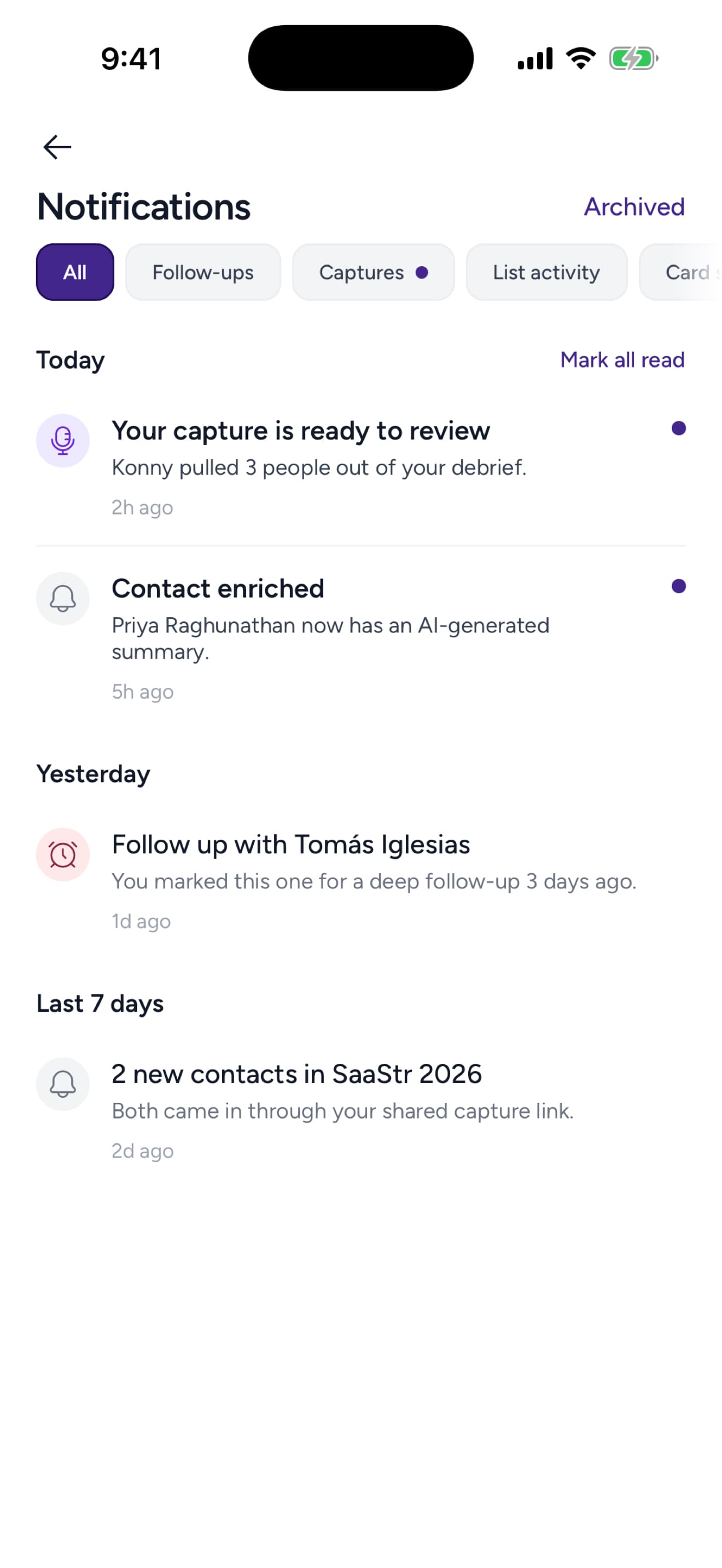
A follow-up reminder appears alongside other updates. Existing Kontextual product-design export; sample content is illustrative.

Leave room for silence
Once you have sent the message, give the other person room to decide what happens next. A lack of reply does not tell you whether they missed it, have too much going on, or would prefer to leave the connection where it is. A casual hello rarely needs a chase, whereas a genuinely useful update may justify one brief follow-up after an appropriate gap. The relationship and the reason for writing matter more than a fixed schedule.
If another message goes unanswered, let it rest rather than trying new channels. Respect a decline immediately, and make sure that “no pressure” is reflected in what you do afterward. A thoughtful message can open a door, but it cannot create an obligation to walk through it.
Make the next conversation easier
If they reply, follow the conversation they are having now rather than steering everything back to the one you remember. Update stale details and record any new promise while it is clear. A useful contact note can be small; it only needs to help you return to the right topic next time.
Kontextual keeps contacts, notes, Lists, and follow-up reminders together, and the web app gives you space to review that context before writing. Use a reminder for something you agreed to do, rather than as a reason to keep nudging someone who has not replied. If the conversation happened recently and you are simply working out the first message, the networking-event follow-up guide is a better place to start.